
FINANCIAL SERVICES. INSURANCE.
Turning Complexity into Confidence, Growth and Trust
Financial services and insurance organisations depend on accurate information, rapid decisions and customer trust. We create connected data environments that provide a clearer view of customers, operations, products and performance. By transforming complex information into timely intelligence, we help organisations identify opportunities, strengthen decision-making and deliver more relevant, responsive experiences across every channel.
AI, predictive analytics and automation enable institutions to operate with greater speed, precision and control. We help organisations improve customer value, anticipate risk, detect unusual behaviour and streamline resource-intensive processes. By combining innovation with security, governance and transparency, we turn Data and AI into sustainable growth, stronger resilience and confident business performance.

DATA-DRIVEN. DECISIONS.
The Decisions Data Should Improve
Financial decisions depend on accurate information, timely analysis and controlled execution. By connecting customer, transaction, product and risk data, organisations can understand performance more clearly, identify opportunities earlier and make confident decisions without compromising governance, security or trust.

Growth and Commercial Performance
Understand product profitability, customer value and changing financial behaviour to improve acquisition, pricing and portfolio decisions. Predictive intelligence helps identify cross-selling opportunities and focus investment on the customers, products and channels with the greatest potential.

Customer Experience
Create a unified customer view across products, transactions and service channels. Personalised recommendations, faster responses and intelligent assistance enable financial institutions to deliver more relevant and consistent experiences.
Operational Excellence
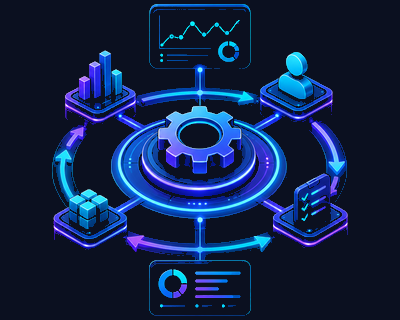
Automate data-intensive processes across onboarding, underwriting, claims, reporting and customer service. Connected workflows reduce processing time, improve accuracy and allow specialists to concentrate on decisions requiring human expertise.

Risk, Compliance and Resilience
Use continuous monitoring and intelligent detection to identify fraud, financial crime, credit exposure and unusual behaviour. Trusted data, traceable decisions and automated controls strengthen compliance and organisational resilience.
KPI. SIGNAL. MONITOR.
The Signals That Matter
Financial institutions must continuously balance profitability, efficiency, customer value and controlled risk. Trusted KPIs bring these dimensions together, enabling leaders to understand portfolio performance, identify emerging exposure and improve decisions across products, channels and customer relationships.
Return on Equity
Measures the profit generated from shareholder equity. It provides a high-level view of financial performance and helps organisations evaluate whether capital is being allocated effectively across products, markets and business activities.
Cost-to-Income Ratio
Compares operating costs with operating income, providing a clear measure of organisational efficiency. Monitoring its underlying drivers helps identify opportunities to simplify processes, automate work and improve profitability.
Asset Quality or Loss Ratio
Banks can monitor non-performing loans and credit quality, while insurers track claims and loss ratios. These indicators reveal whether portfolio risk and losses remain consistent with pricing, underwriting and risk appetite.
Customer Retention and Lifetime Value
Measures the organisation’s ability to maintain profitable customer relationships over time. Connecting retention with product usage and service interactions helps identify valuable relationships and customers at risk of leaving.
Processing Time
Tracks the time required to complete onboarding, applications, underwriting, payments or claims. Shorter and more predictable processing improves customer experience, productivity and the ability to respond at market speed.
Fraud Loss Rate
Measures financial losses associated with fraudulent transactions, claims or applications. Continuous monitoring helps evaluate the effectiveness of detection controls and identify emerging patterns before they create significant financial or reputational impact.
AI. ACTION. IMPACT.
Where AI Creates Impact
AI gives financial services and insurance organisations the ability to understand risk, behaviour and opportunity across increasingly complex data environments. When implemented with strong governance, explainability and human oversight, it can strengthen decision-making, accelerate processes and create more relevant customer experiences.
Predict Risk, Claims and Customer Value
Predictive models can assess credit risk, claim likelihood, customer attrition and long-term value using broader and more timely information. This supports better pricing, portfolio management and customer strategies—provided models are continuously monitored for accuracy, fairness and changing market conditions.
Detect Fraud and Financial Crime
AI can analyse transactions, applications, claims, devices and behavioural patterns to identify suspicious activity that traditional rules may miss. More precise detection can reduce financial losses, strengthen compliance and help investigation teams prioritise the cases that require attention.
Personalise Products and Interactions
AI can determine the most relevant product, message, service or next action for each customer. Responsible personalisation improves engagement, conversion and retention while helping organisations move from generic campaigns towards more useful, timely and customer-centred experiences.
Automate Onboarding, Underwriting and Claims
Intelligent document processing can extract, validate and classify information before routing cases to the appropriate team. Combined with decision-support models and assistants, this can shorten processing times, reduce administrative effort and allow specialists to concentrate on complex judgements and exceptions.